When Airbnb launched in 2008, few hospitality executives believed it would reshape their industry. Today, it's impossible to discuss hotel strategy without addressing the Airbnb impact on hotel industry operations, revenue models, and distribution. The evidence that Airbnb has affected hotels is settled. What matters now is how hotels leverage it.
The Airbnb impact on hotel industry goes deeper than price competition. Over the past 15 years, Airbnb has fractured how travelers book lodging, which segments are most vulnerable, and where growth is concentrated. Some hotels have lost market share in leisure segments while others have discovered new revenue streams by listing themselves on Airbnb. The industry adapted, and the adaptation is still underway.
This article examines the real data behind Airbnb's effect on hotel industry operations, analyzes where the impact is strongest, and explores how the future of lodging involves platforms serving both traditional and alternative distribution channels simultaneously.
How Has Airbnb Affected the Hotel Industry?
Understanding the impact of Airbnb on hotel industry operations requires moving beyond generalizations. The Airbnb effects on hotel industry revenue vary significantly by segment and geography. Budget hotels in major leisure destinations have experienced measurable pressure. Luxury and business-focused hotels have remained largely insulated. The nuance matters because the impact is not uniform, with the effect of Airbnb on hotel industry revenue ranging from negligible in business-travel-dominated markets to substantial in leisure-focused urban centers.
Revenue compression in leisure markets is the most documented effect. STR's analysis of Airbnb and hotel performance data across 13 global markets, covering cities including Barcelona, Boston, Miami, New Orleans, Paris, and San Francisco, found that while hotels maintained higher occupancy and overall pricing power, Airbnb supply grew by 40% or more annually in most markets studied, with some exceeding 100% growth. Airbnb rates undercut hotel rates by an average of $16 per night across the seven U.S. markets analyzed. Research from Boston University quantified the segment-level impact: midscale hotels were hit hardest, with RevPAR declining 4.3% for every doubling of Airbnb supply, while economy hotels saw a 1.5% decline. Economy and midscale hotels compete most directly on price with the growing supply of affordable short-term rentals. The impact is not catastrophic, but it is material. A 4.3% RevPAR decline on a midscale hotel generating $2 million in annual room revenue translates to $86,000 in lost gross revenue, and in high-penetration leisure markets where Airbnb supply has doubled multiple times over, the cumulative effect compounds.
Occupancy rates tell a more complex story. In some leisure markets, Airbnb filled demand that hotels were not serving. Urban areas with high short-term rental caps saw hotels recover occupancy rates that had declined during the COVID-19 pandemic faster than cities with permissive STR regulations. In unregulated markets, the opposite occurred. Airbnb listings expanded to absorb both traditional hotel demand and demand Airbnb itself created.
The pricing pressure is real but measurable. Airbnb's ability to price dynamically, avoid traditional overhead, and aggregate demand outside traditional booking channels compressed nightly rates in high-penetration markets. However, this compression was not across all properties. Luxury hotels actually raised rates during the same period. Budget and mid-scale chains absorbed the impact.
Business travel, a core hotel profit center, remained largely unaffected. While Airbnb has grown its share of business travel bookings from 28% in 2019 to roughly 44% by 2024, the vast majority of that growth came from freelancers, small business owners, and remote workers booking through personal accounts. Corporate-managed travel, where procurement departments control booking channels, remains overwhelmingly hotel-centric. Corporate booking policies, the need for in-building amenities, and reliability requirements keep managed business travelers with established hotel brands. This is why full-service and upper-midscale hotels maintained pricing power in business-travel-dominated markets, even as individual business travelers increasingly used Airbnb for self-booked trips.
Airbnb vs Hotels: Market Share and Growth Data
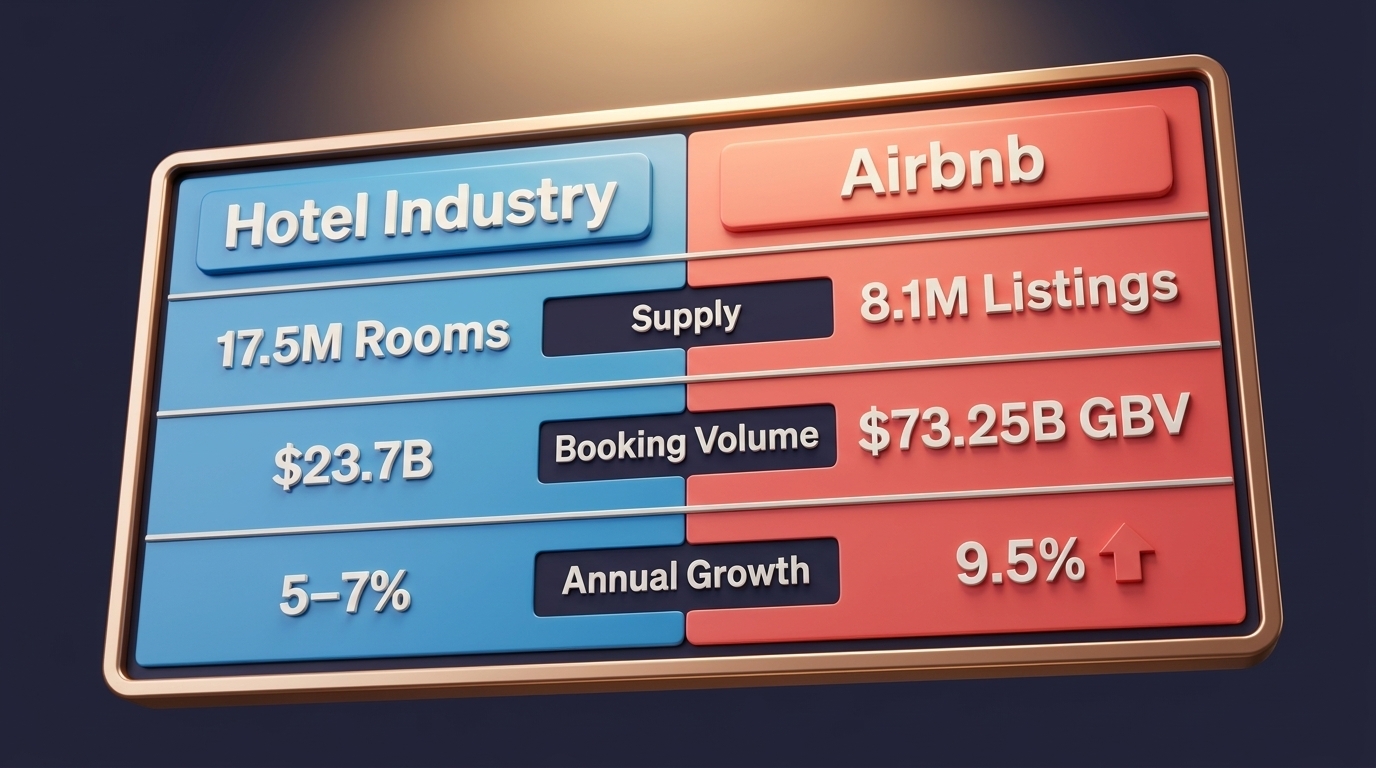
Airbnb's market size relative to the global hotel industry is smaller than many assume, but the trajectory matters. The broader global hospitality market was valued at over $4.6 trillion in 2022, though the hotel room revenue segment is a fraction of that total. Airbnb's gross booking value (GBV) reached $73.25 billion in 2023 and climbed to $82.78 billion in 2024, generating $11.1 billion in platform revenue. By comparison, Marriott International alone reported $23.7 billion in revenue for 2023. Airbnb occupies a significant and growing position, but it remains a marketplace collecting fees on bookings, not an operator bearing the cost of running properties.
Growth trajectories are where the story shifts. Airbnb bookings increased 9.5% in 2024, from 448 million nights in 2023 to 491 million in 2024. The global hotel industry grows at approximately 5-7% annually. Airbnb, despite its maturity, continues growing faster. At current rates, this gap will close meaningfully in the coming decade, and the pace of convergence depends primarily on how aggressively hotels adopt multi-channel distribution.
Listing count provides another lens. Airbnb operates 8.1 million listings globally as of 2024, up from 7 million in 2023. The global hotel count is harder to pin down: Statista reports roughly 187,000 hotel properties with 17.5 million guestrooms worldwide, while broader definitions counting all lodging businesses push the number to over 765,000. Airbnb's listing count far exceeds hotel properties by raw numbers. Yet many Airbnb listings are single rooms, not entire properties, making direct comparison misleading. By "bookable units," hotels still lead with 17.5 million rooms versus Airbnb's 8.1 million listings, but the margin is narrowing. Consider that a single Airbnb property might represent one listing but multiple bedrooms offering separate bookable units, while a small hotel might be one property with dozens of rooms. When analyzed by available sleeping accommodations, the gap closes significantly.
Booking volume shows regional variation. In Europe, where regulatory resistance has been significant, Airbnb's Airbnb vs hotel market share in urban leisure segments exceeds 30-40% in some cities like Berlin, Barcelona, and Vienna. In Asia-Pacific, traditional hotels maintain stronger market dominance, with Airbnb at 8-15% penetration. North America sits between these extremes, with Airbnb capturing 15-25% of leisure bookings in major cities. Las Vegas, Miami, and San Francisco skew toward the higher end of this range.
Year-over-year growth in Airbnb bookings outpaced hotel bookings through 2022 and 2023. This trend moderated in early 2024 as leisure travel cooled and Airbnb's high base made percentage growth harder to achieve. The rate of Airbnb's market share expansion has decelerated, but absolute market share continues rising. This convergence defines the hotel industry vs Airbnb relationship in 2026, where they are no longer strictly competitors but complementary distribution channels. When analyzing Airbnb vs hotel statistics on booking frequency, clear patterns emerge. Hotels show steadier booking patterns with higher business travel volume in shoulder seasons, while Airbnb exhibits more pronounced leisure seasonality, making the two channels complementary in demand distribution.
The Convergence: Hotels and Airbnb Are Becoming the Same Marketplace
The convergence of hotels and Airbnb has moved past theory into measurable market reality. Airbnb's hotel category has become one of its fastest-growing segments, with accommodations in that category growing at double-digit rates year-over-year as of late 2023. Hotels are actively competing through Airbnb's platform, and for many operators the strategic conversation has moved from evaluating whether to list on Airbnb to figuring out how quickly they can activate the channel.
Why is this convergence accelerating? Three factors align with compelling force.
First, Airbnb developed a hotel category designed specifically for traditional properties. Search filters accommodate business travel, pet policies, accessibility features, and standardized amenities. Properties can highlight parking, breakfast, and Wi-Fi in searchable ways. Airbnb created infrastructure tailored to hotel guest expectations. The platform recognized that hotels searching for alternate distribution channels had distinct needs from the hosts offering private apartments. By creating space for institutional properties, Airbnb opened a new revenue stream it had previously ignored.
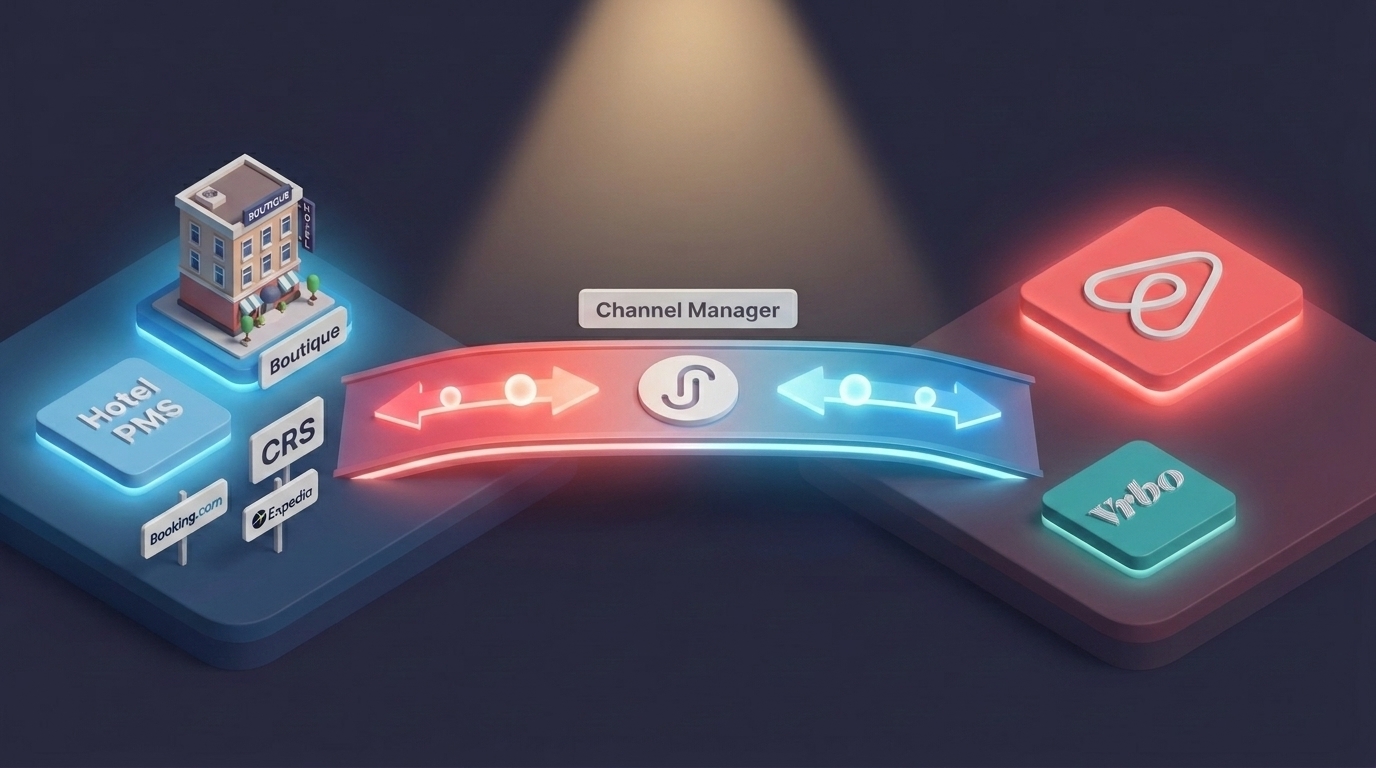
Second, the technology enabling synchronization matured. Modern channel management systems connecting a hotel's property management system (PMS) to multiple platforms can synchronize inventory, rates, and availability across Booking.com, Expedia, Airbnb, and VRBO in real time. That connectivity removed the technical barrier. But the technical connection is the straightforward part. Airbnb was not built for the hotel technology stack, and operating on it introduces complexity that traditional OTA distribution does not. Airbnb requires 24/7 guest messaging, and response time is a ranking factor on the platform. Rate management works differently: length-of-stay pricing, BAR strategies, and rate parity rules do not translate directly from hotel CRS logic to Airbnb's pricing model. Listing optimization, photography standards, and review management all add operational overhead. Hotels that treat Airbnb as "just another channel manager toggle" underperform hotels that invest in platform-specific expertise. Companies like Jetstream exist specifically to handle this complexity, managing the operational layer between a hotel's existing systems and the unique requirements of STR platforms like Airbnb and VRBO.
Third, Airbnb's traffic and booking intent became undeniable. Hotels recognized that alternative booking platforms now generate material revenue. A mid-scale hotel capable of capturing even 10-15% of rooms from Airbnb guests adds meaningful revenue with minimal additional operational cost. For a 200-room hotel, an extra 20-30 rooms per night through Airbnb distribution represents $730,000 to $1.1 million in incremental annual revenue at a mid-range rate. The margin on an incremental Airbnb booking is substantial because occupancy costs are fixed. Labor, utilities, and facilities operating costs remain constant whether the room is booked on Booking.com or Airbnb.
Hotels accessing STR guest demographics through Airbnb distribution gain visibility to travelers who would never visit a hotel booking site. These are guests who would not have booked through traditional hotel channels at all. A guest booking a two-week stay for a personal project or relocation is more likely to search Airbnb than a hotel site. A family seeking a "local neighborhood experience" with a kitchen and space for spreading out is searching Airbnb. These travelers go to hotels if the right property is available in the right format. By making hotel properties visible on Airbnb with kitchen amenities, longer-stay discounts, and neighborhood-specific storytelling, properties capture guests they would otherwise lose entirely.
The technology stack enabling this convergence has multiple layers, and the complexity increases as you move past connectivity. A modern hotel technology stack includes a PMS handling reservations and guest services, often coupled with a central reservation system (CRS) managing inventory across direct channels. A channel manager acts as an intermediary, sending real-time availability and pricing to OTAs like Booking.com and Expedia. The same channel manager can now push data to Airbnb and VRBO. That inventory synchronization piece is solved. What is not solved by the channel manager alone is everything that happens after the booking: guest communication on a platform that penalizes slow response times, content that must be written for a traveler mindset fundamentally different from a Booking.com or Expedia shopper, dynamic pricing tuned for Airbnb's algorithm rather than traditional OTA rate strategies, and review management that directly impacts search visibility. The hotels succeeding on Airbnb are those pairing their existing PMS and channel manager infrastructure with specialized distribution partners who understand how STR platforms actually work from the inside.
This creates a unified marketplace. A traveler shopping across platforms sees mostly the same inventory, just presented differently. A hotel on Booking.com, Airbnb, and direct channels is selling the same rooms through three storefronts, and the modern hotel operates as a multi-channel retailer, optimizing for occupancy and revenue across all available channels simultaneously. The old framing of "Airbnb or hotels" has been replaced by "hotels everywhere." Hotels exploring how to use STR channels without losing direct bookings are finding that both channels can coexist profitably.
What's Next: Predictions for Hotel-STR Relations
The trajectory suggests three near-term shifts that will shape the next five years of hotel-STR dynamics.
First, convergence will deepen. More hotels will list on Airbnb and VRBO, and Airbnb will add more hotel properties to its platform. This is not a trend that will reverse. It reflects how markets actually work when two platforms serve slightly different use cases but overlapping demand pools. Within three to five years, most upper-midscale and above hotels in leisure-oriented markets will actively distribute on alternative platforms. Budget chains will follow, recognizing that they cannot afford to ignore high-traffic booking surfaces. The Airbnb effect on hotel industry distribution will be less about competition and more about comprehensive channel coverage.
Second, regulation will remain fragmented but increasingly formalized. Cities will not ban short-term rentals entirely, but they will standardize rules. Some destinations will cap Airbnb listings; others will require licensing or impose new taxes. Barcelona's decision to phase out entire-property Airbnb listings by 2028 signals a regulatory trend toward limiting short-term rental supply in constrained housing markets. Regulation will make STR less chaotic but also more legitimate, reducing barriers for hotels to participate. A properly regulated STR market actually favors established hospitality operators with brand recognition, financial stability, and compliance infrastructure. Hotels can navigate licensing and tax complexity more easily than casual hosts, making hotels' Airbnb presence increasingly advantaged in regulated markets.
Third, technology consolidation will accelerate. Platform switching costs for hotels remain high. A hotel that distributes across five channels with three different channel managers faces operational complexity, inconsistent pricing, and manual reconciliation work. As the market matures, hotels will demand integrated solutions handling OTA, alternative platform, and direct distribution simultaneously.
"Hotels think that as soon as they enable a channel on a channel manager or PMS, it's just going to work. In reality, making a single channel perform really well requires a lot of technological complexity, a lot of features, and frankly still a lot of effort. It's not set and forget. You need technology that is an expert in specific channels to be successful on those channels."
— Emmanuel Lavoie, CEO, Jetstream Hospitality Solutions
The companies that win will offer unified pricing, inventory, and revenue management across all channels from one interface, with deep expertise in each platform's unique requirements. Hotels that currently manage Booking.com through one vendor, Airbnb through another, and direct channels through a third will consolidate around single solutions.
The data points in one clear direction: hotels that add STR channels to their distribution mix consistently outperform those relying exclusively on traditional OTAs. This performance gap has widened since 2021 and shows no signs of closing. Hotels with diversified distribution report 2-5% higher occupancy and 3-7% higher RevPAR compared to hotel peers in the same market using traditional channels exclusively. The performance gap reflects real demand pools that Airbnb and VRBO access that Booking.com and Expedia do not.
Hotels that outperform over the next decade will be those treating Airbnb and VRBO as distribution channels complementing Booking.com and Expedia. That means investing in technology to manage multi-channel complexity, training staff to serve the different communication styles and amenity expectations Airbnb guests bring compared to business travelers on Expedia, and optimizing pricing across platforms dynamically so that weekend leisure rates on Airbnb support premium positioning unavailable on corporate OTAs. Hotels applying urban vs. leisure strategy adjustments to match these channel-specific needs will capture a larger share of leisure demand while maintaining pricing power in business segments.
Hotels that continue viewing Airbnb purely as a competitive threat will absorb rate pressure without offsetting volume gains, maintaining outdated distribution approaches while competitors capture new demand pools. A single-channel hotel facing rate pressure from Airbnb listings has limited defensive options. A multi-channel hotel can optimize pricing, shift demand to underutilized channels, and serve diverse traveler segments. The strategic position is simply stronger.
The hotel industry's future with Airbnb looks less like a war and more like a shared marketplace where the same hotel serves guests from multiple platforms, optimizing for total revenue and occupancy. The platform boundaries that seemed clear in 2012 have become irrelevant because a guest booking a property does not care whether the booking came through Airbnb, Booking.com, or direct. They arrived at the same room using whatever technology made sense for their travel profile. The technology enabling this fluidity already exists, and early adopters have gained meaningful head starts. Hotels entering this transition now have a two to three-year window to build competitive advantages before the market matures and multi-channel distribution becomes table stakes. For hotels and resorts evaluating their next move, the data and the technology are both ready, and the window to gain an early-mover advantage is narrowing.
The data points in one direction: hotels that add STR channels to their distribution mix consistently outperform those relying exclusively on traditional OTAs. This performance gap has widened since 2021 and shows no signs of closing. The technology to make this work without operational chaos already exists, and early adopters have a meaningful head start. If your hotel is evaluating where Airbnb and VRBO fit in your distribution strategy, Jetstream can help.