4 min read
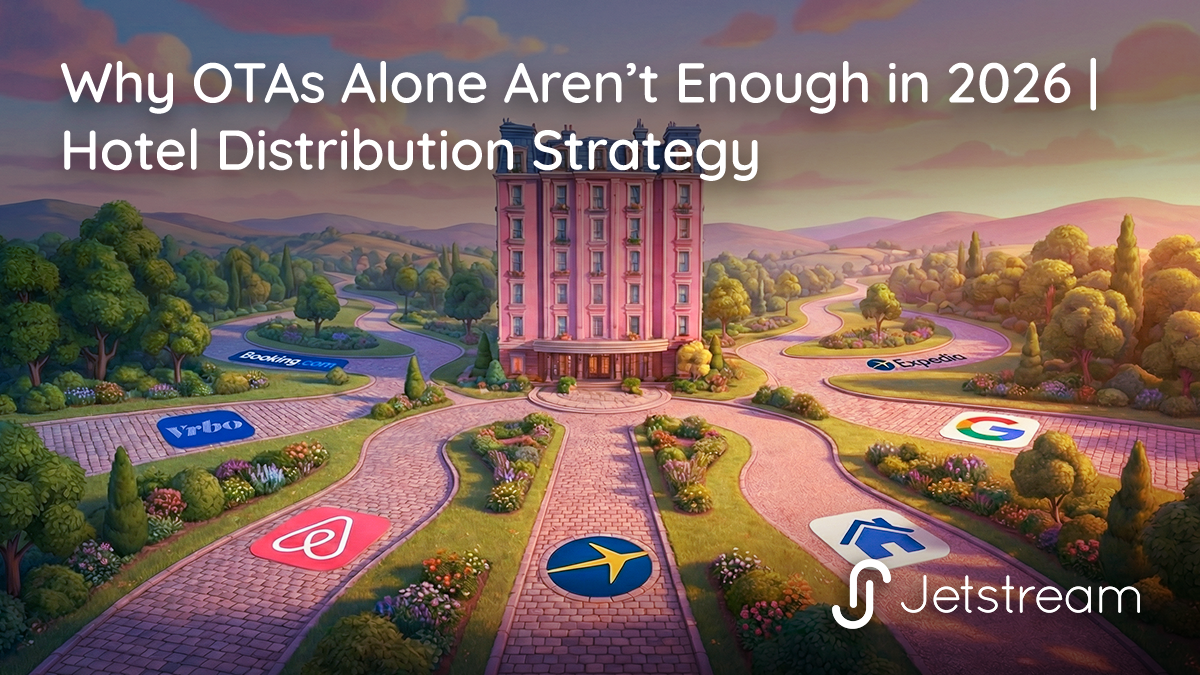
Why OTAs Alone Aren’t Enough in 2026 | Hotel Distribution Strategy
Jetstream
Feb 19, 2026 7:07:27 PM
The Limits of an OTA-Only Strategy
An OTA-only strategy limits growth in 2026 because commissions rise faster than net revenue while stay patterns stay short.
Online travel agencies like Booking.com and Expedia still matter. They deliver visibility and short-stay demand at scale. The issue is not usage. The issue is dependence.
Most hotels pay 15 to 25 percent commission on OTA bookings. That cost does not decrease as volume increases. Industry reporting from Skift shows these rates have remained stable even as labour and operating costs have climbed. Read the breakdown of how much hotels really pay OTAs on Skift.
As OTA share grows, distribution cost per occupied room grows with it. That is simple math.
The problem is that many performance reviews still focus on occupancy and gross ADR. Those metrics look healthy while net ADR and net RevPAR quietly decline. You fill rooms, but you give back margin.
OTA-heavy mixes also skew toward:
- Shorter average length of stay
- Higher turnover and housekeeping cost per night
- Less pricing control during high-demand periods
None of this means OTAs are broken. OTAs are optimised for comparison shopping and fast decisions. That optimisation favours one- to two-night stays. It does not favour longer stays or incremental nights that lift total booking value.
This creates a ceiling.
Once a hotel reaches a certain level of OTA dependence, adding more OTA volume rarely adds proportional profit. It adds cost. Growth stalls even when demand exists.
Is Your OTA Growth Still Profitable?
Let’s break down how OTA share impacts net ADR, length of stay, and true revenue per booking in your portfolio.
This is why OTA-only distribution stops working as a strategy in 2026. The market has moved beyond it.
Jetstream helps hotels break through this ceiling by expanding distribution into channels that support longer stays and incremental demand without cannibalising direct bookings. Learn how the Jetstream channel distribution platform works here.
In the next section, the question becomes clear. If OTAs still matter, but cannot do everything, where do commercial leaders go next?
Why OTAs Still Matter (and Where They Fall Short)
OTAs still matter because they deliver reliable demand, but they fall short because reliability does not equal efficiency.
Online travel agencies continue to play a central role in hotel distribution. Platforms like Booking.com and Expedia invest heavily in demand acquisition and convert well for short, price-driven stays.
That scale explains why OTAs remain a core channel. According to Phocuswright’s U.S. Online Travel Overview, OTA gross bookings exceed $100 billion annually, reinforcing their position in the market.
The limitation appears when OTAs dominate the mix.
As OTA share rises, performance often looks strong on the surface. Occupancy improves. Pickup is consistent. But commission, cancellations, and short stays quietly erode net results.
OTA bookings typically skew toward shorter stays and peak-night demand. That design works well for volume, but it does not optimise revenue per booking or operational efficiency.
In 2026, the challenge is not getting rooms booked. It is converting demand into profitable stays.
This is why OTAs still belong in the mix, but no longer belong at the centre of the strategy.
Why OTA vs Airbnb Is the Wrong Debate
The real issue is not OTA vs Airbnb. The real issue is which channels add incremental demand.
OTAs are optimised for short, comparison-driven stays. Airbnb is optimised for stay-based demand. Comparing them as substitutes misses the strategic point.
Airbnb attracts longer stays and block bookings. Reuters reports that 28+ day stays account for roughly 17 to 18 percent of Airbnb’s bookings, a sharp increase from pre-pandemic levels, driven by extended leisure and hybrid travel.
Longer stays change the math. They increase total booking value and reduce turnover frequency, which lowers housekeeping cost per occupied night.
This is why Airbnb should not be treated as an OTA replacement. It functions as an incremental channel that captures demand OTAs under-deliver.
For hotels, the opportunity is not to shift volume away from OTAs. It is to add channels that extend length of stay without cannibalising existing bookings.
Channel-Mix Math: Where Incremental Revenue Comes From
Incremental revenue comes from total booking value, not nightly rate alone.
ADR is useful, but it only tells part of the story. It ignores length of stay, distribution cost, and labour per booking. Two bookings with the same ADR can deliver very different results.
A better metric is revenue per booking.
Revenue per booking captures nightly rate and length of stay in a single number. Industry data supports this shift. SiteMinder’s hotel booking trends show that direct bookings generate higher average revenue per booking than OTA bookings, largely because they include longer stays and lower fees.
Length of stay is the multiplier.
Longer stays reduce housekeeping frequency, lower labour cost per occupied night, and increase net contribution per booking. This is why STR-style demand often improves profitability even when nightly rates are similar.
Hotels that optimise channel mix focus less on filling nights and more on maximising value per stay.
See the Channel-Mix Math Behind Your Revenue
We’ll model how longer stays and incremental demand could shift total booking value across your current distribution.
Why 2026 Is a Distribution Turning Point
2026 is a turning point because traveller behaviour has changed, while many distribution strategies have not.
Demand is no longer dominated by short, transactional trips. Extended leisure, hybrid work travel, and longer stays now represent a larger share of bookings.
At the same time, Airbnb has begun piloting hotel inventory in select markets, signalling that hotels are increasingly compatible with STR-style demand. Skift has reported pilots involving independent and boutique hotels in major cities, including New York, Los Angeles, and Madrid.
This shift matters.
STR platforms are no longer just alternatives to hotels. They are becoming distribution channels for specific stay behaviours that OTAs were not designed to capture.
Hotels that adapt gain access to incremental demand and longer stays. Hotels that do not remain dependent on channels optimised for a narrowing slice of traveller intent.
In 2026, distribution advantage will come from diversification, not dependency.
What a Smarter 2026 Distribution Strategy Looks Like
A smarter 2026 distribution strategy balances volume, margin, and stay behaviour instead of maximizing a single channel.
OTAs still matter. They deliver visibility and short-stay demand efficiently. But they are not designed to maximise length of stay or total booking value, which is where incremental revenue now comes from.
Direct channels remain critical for margin control. They support loyalty, upsell, and pricing flexibility, and they consistently deliver higher revenue per booking than third-party channels, as shown in SiteMinder’s hotel booking trends research.
STR channels add a third layer. They capture longer stays, shoulder-night demand, and hybrid travel patterns that OTAs underperform. These stays often reduce housekeeping frequency and labour cost per occupied night while increasing total booking value.
The goal is not replacement. The goal is balance.
In an optimised mix:
- OTAs support baseline demand and compression periods
- Direct channels protect margin and brand control
- STR channels extend length of stay and booking value
This balance also aligns with operational reality. Labour shortages remain a top constraint for hotels, according to the American Hotel & Lodging Association. Longer stays and lower turnover reduce pressure on already stretched teams.
Jetstream helps hotels execute this strategy by enabling STR distribution through hotel-friendly systems and workflows, without cannibalising direct bookings or adding manual work.
Your Next Step
OTAs are no longer the growth lever they once were. Channel mix is.
If you want to understand how a smarter mix could increase length of stay and revenue per booking in your portfolio, the next step is simple.
Quantify where incremental value already exists in your current distribution.
Our top picks |
|
|
READ: How Jetstream Powers Vail Resorts’ Airbnb and VRBO Strategy |
WATCH: CEO of Jetstream Shares Growth Tips for Airbnb & VRBO |
Related Posts