8 min read
Why Are Hotel Rooms on Airbnb? The Trend Reshaping Hospitality
Jetstream
Apr 27, 2026 9:24:55 AM
If you've searched for a hotel and found listings from actual hotel properties on Airbnb, you're witnessing a quiet but significant shift in how the hospitality industry operates. Over the past few years, more hotels have begun listing rooms on Airbnb, from independent boutiques to established resort chains. This isn't an accident or a niche experiment. Why are hotel rooms on Airbnb becoming more common? The answer lies in revenue strategy, market access, and the changing preferences of leisure travelers.
Hotels are listing rooms on Airbnb for one primary reason: to reach a guest segment that traditional hotel channels miss. Airbnb hosts 150 million guests annually, and a substantial portion of them have different search patterns, booking behaviors, and demographic profiles than guests using conventional OTA channels like Booking.com or Expedia. By claiming space on Airbnb, hotels diversify their revenue streams and reduce dependency on commission-heavy traditional distribution partners.
This trend represents a fundamental rethinking of hotel distribution. Rather than waiting for guests to find them through corporate websites or mainstream booking engines, hotels are meeting travelers where they actively search. Most operators have moved past debating whether hotels belong on alternative platforms and are now focused on managing the operational complexity that comes with serving multiple channels simultaneously.
Why Hotels Are Listing Rooms on Airbnb
The shift toward Airbnb started in earnest around 2022 when the platform made a deliberate push to formalize its presence in the hotel space. Airbnb has always hosted some accommodations that look like hotels, but the company worked to make hotel listings more legitimate and transparent. Today, Airbnb explicitly welcomes hotels and resorts, creating dedicated listings categories and tools to help properties manage inventory.
Hotels benefit most from this expansion when they fit specific profiles. Boutique hotels and independent properties see the greatest upside because Airbnb's audience actively seeks unique, locally-rooted accommodations rather than standardized chain experiences. A 50-room indie hotel in a trendy neighborhood attracts a different price-point and psychographic than a 200-room chain property. Airbnb guests often pay premiums for character, design, and authentic location experiences, which aligns perfectly with how boutique properties position themselves. Resort properties also benefit, particularly those in leisure destinations where weekend getaways and longer stays dominate the market.
The core advantage is access to new guests. Hotels listing on Airbnb tap into a massive audience of people who may never type "hotel near me" into Google. Instead, they search for experiences, neighborhoods, or travel keywords on Airbnb, and discovering a well-positioned hotel room alongside vacation rentals can convert them into bookers. This is especially powerful for off-peak seasons when traditional OTA booking pressure is low and inventory sits vacant.
How Do Hotel Rooms End Up on Airbnb?
Understanding how hotel rooms appear on Airbnb matters because the path to distribution varies. Some hotels manage their Airbnb presence directly, creating and maintaining listings themselves with their own teams. Others use third-party resellers who list properties across multiple platforms without the property's direct involvement, though Airbnb has tightened its verification processes to reduce unauthorized listings.
The most common path today is direct listing by hotel operators. A hotel decides to target Airbnb, creates a listing, uploads photos, writes a property description, and sets pricing. From there, the hotel team must manually manage reservations, update availability across channels, and coordinate with their existing PMS (property management system). This works at small scale, but when a hotel manages both traditional OTA channels and Airbnb, keeping availability synchronized becomes a significant operational headache. For a detailed walkthrough of this process, see the complete guide to listing hotels on Airbnb and VRBO.
This is where channel management technology enters the picture. Modern channel managers can sync a hotel's PMS directly to Airbnb, automating availability updates, rate changes, and reservation flow. Rather than updating each platform individually, a channel manager acts as the bridge, ensuring that when a guest books one room on Booking.com, that inventory disappears from Airbnb simultaneously. Without this automation, hotels risk overbooking, disappointing guests, and damaging their reputation across multiple platforms.
The difference between hotels listing directly and working with a distribution partner matters. Direct listings mean the hotel handles its own presentation, pricing, and guest communication across every channel. Full-service distribution partners like Jetstream take a different approach, managing the entire Airbnb and VRBO presence on behalf of the hotel so the property team can focus on operations and on-site guest experience. The right model depends on a hotel's internal capacity. Properties with dedicated distribution teams may manage channels in-house, while hotels that want the revenue without the operational overhead tend to work with a partner who specializes in alternative channel distribution.
Are Hotels Cheaper on Airbnb?
One of the most common questions guests ask is whether booking a hotel on Airbnb saves money compared to booking the same hotel through traditional channels. The answer depends on several factors, particularly commission structures and pricing parity rules.
Airbnb's fee model differs from Booking.com and Expedia. When a guest books on Airbnb, they pay a service fee (15.5% of the nightly rate) plus a cleaning fee if the property charges one. Airbnb then takes a percentage from the property. Traditional OTAs like Booking.com charge hotels a commission ranging from 15-25%, depending on negotiated rates. Expedia's model is similar. The guest-facing fees on Airbnb can sometimes appear lower, but this reflects the platform's fee structure, not necessarily lower nightly rates.
Pricing often differs between platforms because hotels have flexibility in setting rates per channel. A hotel might offer a lower rate on its direct website, a mid-tier rate on Booking.com, and a slightly higher rate on Airbnb to compensate for its unique audience and different commission structure. However, hotels typically maintain what's called rate parity, meaning rates across channels stay roughly aligned to avoid channel conflicts and OTA contract violations.
When booking a hotel on Airbnb might save money depends on timing and the specific property. If a hotel offers a promotional rate exclusively on Airbnb to fill off-peak inventory, you could find a better deal there than on Booking.com. Seasonal pricing also plays a role. During high-demand periods, Airbnb rates may spike differently than traditional OTA rates. The safest approach is to compare the total cost (nightly rate plus all fees) across platforms before booking.
The Revenue Case: Why Hotels Do This
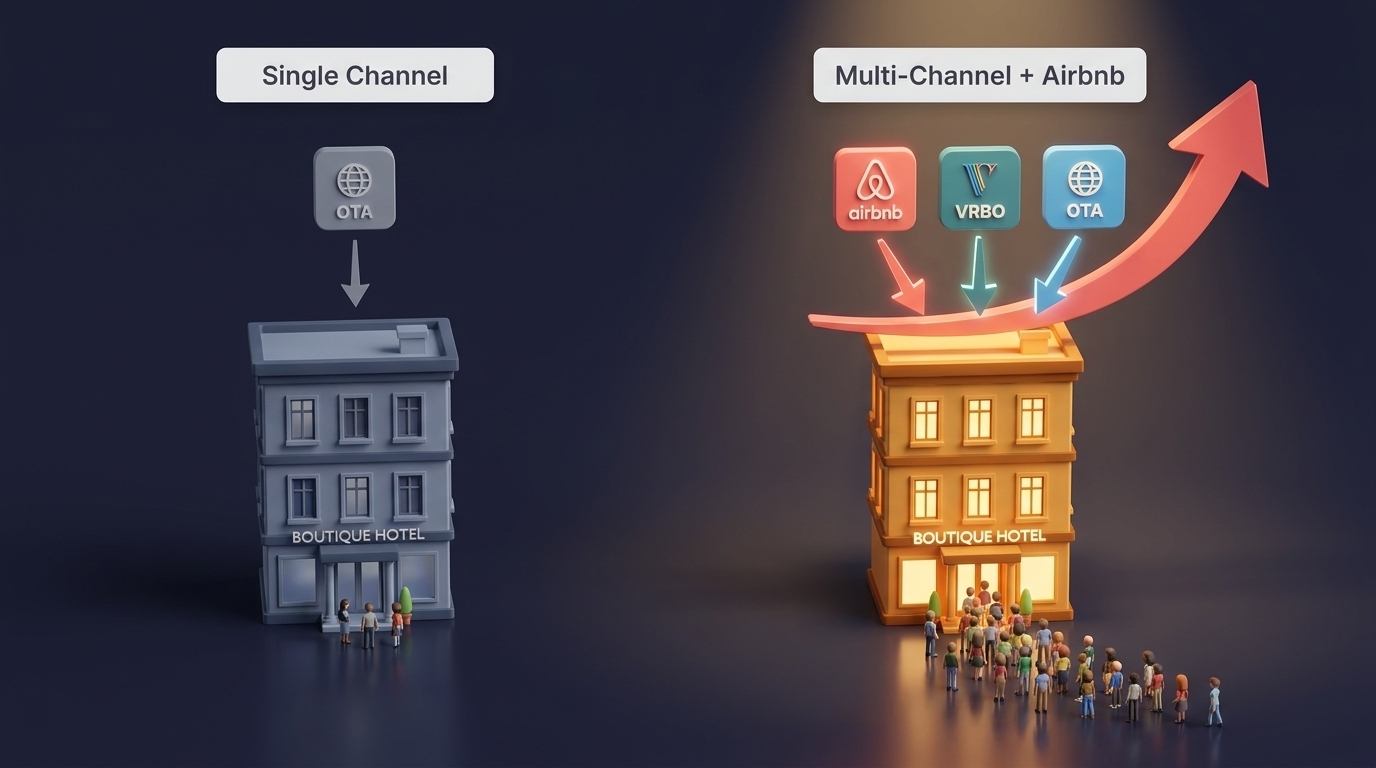
The financial rationale for listing on Airbnb centers on three dynamics: audience reach, inventory utilization, and ADR (average daily rate) optimization.
First, audience reach is substantial and distinct. Airbnb's 150 million global users include a demographic skew toward younger, independent travelers and experiential seekers. This audience differs meaningfully from the corporate bookers and leisure travelers who dominate traditional OTA channels. A hotel targeting this segment gains access to millions of potential guests who may never see their Booking.com listing because they don't search that way. For boutique hotels and properties positioned around unique experiences, this reach can fill rooms that might otherwise sit empty.
"The most common misconception is that hoteliers just don't believe Airbnb is a useful channel. They tend to work in their own narrow box of direct bookings, brand bookings, Booking.com, and Expedia. The second most common is that Airbnb is only for bigger homes and units. They don't think small hotel rooms without kitchens will be successful, which is very far from the truth these days."
— Ben Day, CRO, Jetstream Hospitality Solutions
Second, inventory utilization directly impacts revenue. A hotel with 50 rooms typically targets 75-85% occupancy to hit financial targets. In shoulder seasons or on weekdays in leisure markets, occupancy often falls below that threshold. Airbnb's audience frequently includes guests willing to book shorter notice or book mid-week stays if the price is right. By opening inventory to Airbnb, hotels fill gaps in their occupancy calendar with revenue they wouldn't otherwise capture.
"We see our best hotel and resort partners with 6-10% of their room nights booked through the Jetstream channel from Airbnb and VRBO. When we first started working with Vail Resorts, we set modest expectations. Then bookings grew 100 to 200 percent year over year. We saw increased engagement, an increased appetite to add more resorts from their portfolio to the Jetstream program, and a genuine desire to understand our market intelligence data."
— Ben Day, CRO, Jetstream Hospitality Solutions
Third, ADR optimization is where Airbnb truly shines for the right properties. Independent hotels and boutiques can command pricing premiums on Airbnb compared to traditional OTA channels because the platform's audience expects to pay for unique, design-forward, or locally-rooted properties. A mid-range independent hotel might see a 10-15% ADR uplift on Airbnb compared to its Booking.com rate because Airbnb guests value character and differentiation over price alone. For every guest that books on Airbnb at a higher rate, the hotel gains margin even after accounting for Airbnb's commissions.
Finally, reducing dependency on traditional OTAs protects hotel margins long-term. Booking.com and Expedia charge commissions that have climbed steadily over the past decade, sometimes exceeding 25%. As OTA commissions rise, hotels seek alternative channels to restore margin. Airbnb offers leverage. As we explored in why OTAs alone aren't enough in 2026, by proving they can distribute inventory outside traditional OTA ecosystems, hotels negotiate better rates with their existing partners or reduce reliance on them altogether. The final case for listing on Airbnb and VRBO goes deeper into the revenue math.
The Challenges Hotels Face on Airbnb
Despite the revenue opportunity, hotels encounter real operational friction when managing Airbnb listings alongside traditional channels.
Guest expectations differ noticeably. Airbnb has cultivated a community culture that emphasizes communication, reviews, and direct host-guest interaction. The platform tracks whether hosts respond to guest inquiries within one hour and publicly displays that response rate on the listing. Falling below the one-hour threshold hurts search ranking within Airbnb's algorithm, which means a slow hotel team doesn't just frustrate one guest; it reduces visibility for every future booking. Beyond speed, Airbnb guests expect detailed information about check-in logistics and personalized touches that feel more like a host relationship than a hotel transaction. A hotel team trained for corporate booking channels must shift its communication style, responsiveness, and operational mindset to succeed on Airbnb. This cultural shift takes training and process changes that many hotels underestimate.
Managing inventory across platforms creates complexity at scale. If a hotel manages Booking.com, Expedia, and Airbnb manually, every rate change, availability update, and cancellation policy adjustment must be replicated across three systems. A mistake, such as forgetting to close a room on one channel after it's booked on another, leads to overbooking. The operational load grows exponentially with each new channel added, especially in hotels without a dedicated distribution manager.
Review management adds another layer. Airbnb has its own review ecosystem, ratings algorithm, and guest expectations around response time to reviews. A 4.8-star rating on Airbnb sends different signals than a 4.3-star rating on Booking.com, and guest review language differs by platform. Hotels must monitor, respond to, and manage reviews on each channel separately. A single negative Airbnb review can impact future bookings because Airbnb's algorithm factors reviews heavily into search rankings.
The technology gap is perhaps the most significant barrier. Most hotel PMS systems were built to integrate with traditional OTA channels decades before Airbnb became a serious distribution player. Native integrations between modern PMS platforms and Airbnb exist, but not every PMS supports them natively. Older properties operating legacy systems face a choice: invest in a new PMS, use a third-party channel manager as a bridge, or manage Airbnb manually. Each path carries cost and complexity tradeoffs.
How Channel Managers Bridge the Gap
Channel management software exists precisely to solve the operational challenges hotels face when distributing across multiple platforms. A channel manager acts as a centralized hub that connects a hotel's PMS to Airbnb, Booking.com, Expedia, and other platforms simultaneously.
In practice, the workflow is straightforward. A hotel team updates rates, availability, and reservation information once in their PMS. The channel manager automatically syncs those updates across every connected platform in real-time. When a guest books a room on Airbnb, the channel manager pushes that reservation back to the hotel's PMS, updates availability on Booking.com and Expedia, and ensures the room no longer sells on any other channel. This eliminates overbooking, manual updates, and coordination errors.
Automated rate and availability management is the core value proposition. Hotels can set rules such as "maintain a 5% price premium on Airbnb compared to Booking.com" or "close availability on Airbnb if occupancy reaches 90%," and the channel manager enforces those rules automatically. Seasonal pricing, last-minute discounts, and dynamic rate adjustments apply instantly across all channels. For properties with variable demand or sophisticated revenue strategies, this automation is transformational.
For hotels serious about multi-channel distribution as a revenue strategy, not a side project, channel management technology is essential infrastructure. Hotels that treat Airbnb as a secondary, manually-managed experiment tend to struggle with consistency and operational load, while those integrating it into a cohesive, automated distribution system see the clearest revenue uplift and the lowest operational friction. Jetstream is purpose-built for exactly this use case, connecting hotel PMS systems to Airbnb and other alternative distribution channels so hotels can operate a genuinely integrated, multi-channel strategy without manual overhead.
Why Hotel Rooms on Airbnb Are Here to Stay
The trend of hotel rooms on Airbnb is not a phase. It reflects a structural shift in how travelers search for accommodations and how hotels think about distribution. The revenue case is clear: new guest segments, better inventory utilization, and ADR upside that traditional OTAs alone cannot deliver. The challenges are real but solvable, particularly for hotels willing to invest in channel management technology and adapt their operational playbook to a platform with different communication expectations and ranking mechanics. For hotels and resorts evaluating their distribution strategy, the question worth asking is how to do it in a way that protects the brand, serves guests well, and actually moves the revenue needle.
The hotels seeing the best results on Airbnb treat it as a serious distribution channel, not a side project. The right channel management technology removes operational friction and lets hotel teams focus on what they do best: delivering great guest experiences. If you're exploring how STR channels could fit into your hotel's distribution strategy, Jetstream specializes in exactly this.
Our top picks |
|
|
READ: How Jetstream Powers Vail Resorts’ Airbnb and VRBO Strategy |

WATCH: CEO of Jetstream Shares Growth Tips for Airbnb & VRBO |