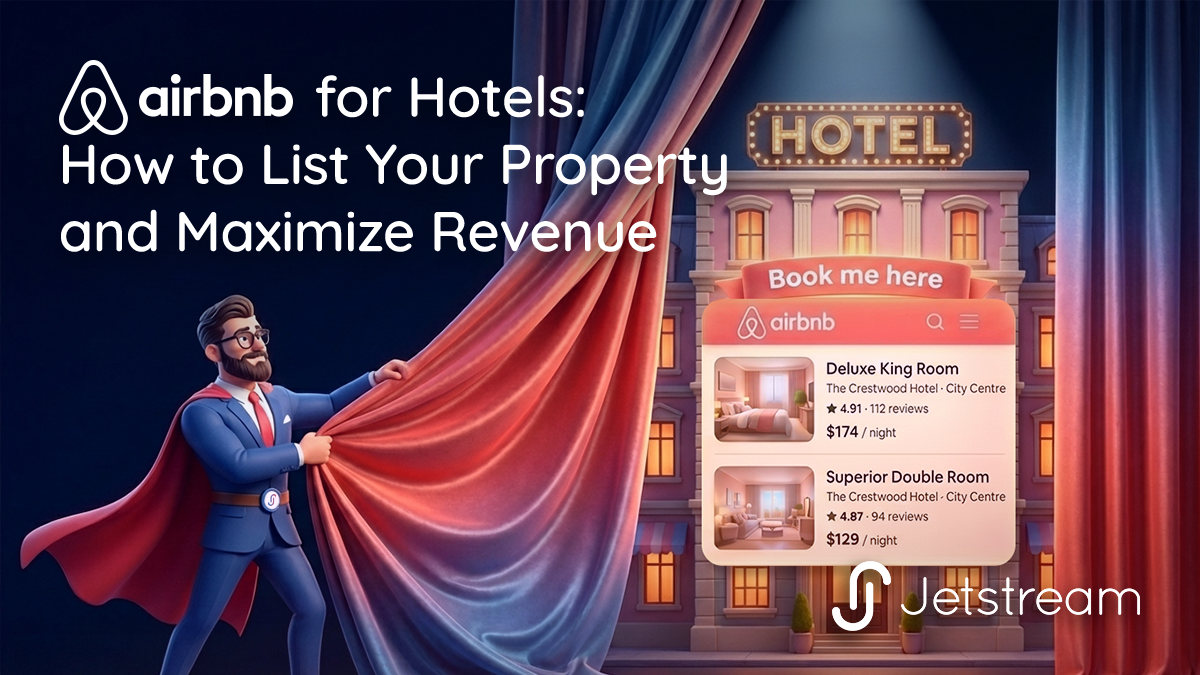
How Do I Add My Hotel to Airbnb?
The setup process for hotels on Airbnb has more steps than a typical vacation rental listing because of the hospitality category requirements.
The basic flow looks like this. First, you create a host account or upgrade an existing one to access Airbnb's professional hosting tools. Second, you select the listing type that matches your property: hotel, boutique hotel, hostel, resort, or serviced apartment. Third, you complete the listing profile with photos, descriptions, amenities, and house rules. Fourth, you set your pricing strategy and availability calendar. Fifth, you publish and start optimizing based on early bookings and reviews.
The detail that catches most hotels off guard is the photography and content standards. Airbnb's audience expects lifestyle photography (the room with morning light, the lobby that looks like a place you want to spend time, the rooftop bar with people in it) rather than the catalog-style photography most hotels already have on file for OTA distribution. Properties that update their photos for Airbnb's audience consistently outperform properties that recycle their Booking.com gallery.
For hotels with multiple room types, the listing structure question is operational. Some hotels list their entire inventory as separate room types within one Airbnb listing. Others create individual listings for each room category to capture more search visibility. Both approaches work; the right choice depends on how much volume you want to drive through Airbnb and how your channel manager handles multi-listing inventory sync.
What Percentage Does Airbnb Take from Hotels?
Airbnb's commission structure for hotels uses a host-only fee model, where the property pays the full service fee and the guest sees a fee-free price. The standard host-only fee for hotels typically lands at 14 to 16 percent of the booking value, depending on the listing type and market. Some markets and listing categories have variations, but 14 to 16 percent is the working range.
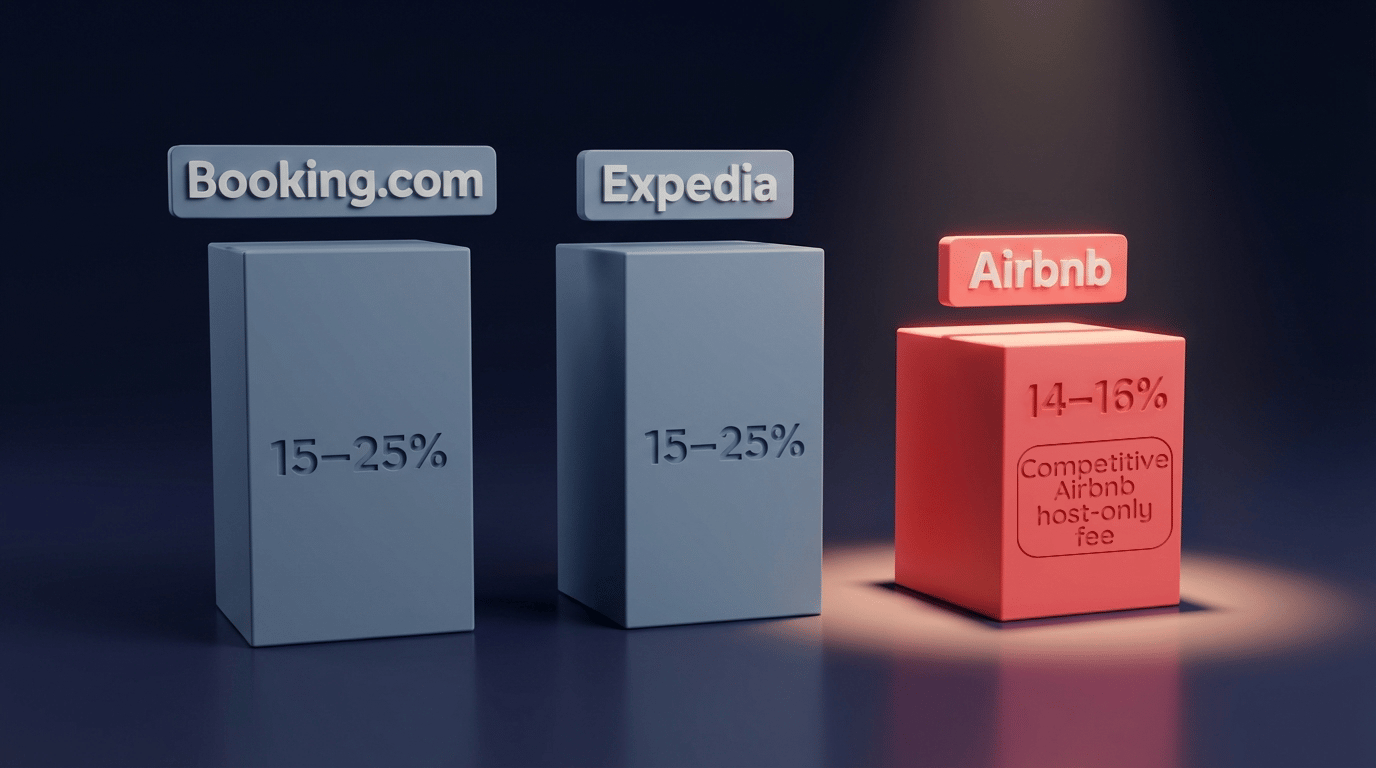
Compared to traditional OTA commission rates, that lands competitively. Booking.com and Expedia commissions for hotels typically range from 15 to 25 percent depending on negotiated terms, market, and rate plan. Airbnb's host-only model is often slightly cheaper than what hotels pay on traditional OTAs, especially for properties without preferred-partner status.
The net revenue picture also depends on cancellation policy and average length of stay. Airbnb bookings tend to run longer, which means more revenue per reservation even at a comparable per-night rate. For hotel operators, the relevant calculation isn't just commission percentage; it's net revenue per booking after commission, factoring in stay length and rate flexibility. On that basis, Airbnb often outperforms traditional OTAs for the right inventory, particularly for hotel rate plans that have been adapted properly for the Airbnb audience.
The Challenge: Managing Airbnb Alongside Your Existing Channels
The operational reality of running Airbnb as a hotel channel is straightforward as long as the technology is set up properly. It breaks down quickly without it.
Three things have to stay synchronized across all your channels. Rates need to flow consistently so you don't end up with a higher price on Booking.com than on Airbnb, or vice versa, in ways that create rate parity disputes. Availability needs to update in real time so a booking from Airbnb closes the room on Booking.com, Expedia, and your direct site within minutes, not hours. Guest communication and reservation data need to land in your PMS so the front desk knows who's checking in regardless of which channel produced the booking.
For a hotel managing this manually with a small inventory, it's possible but exhausting. Staff have to update Airbnb pricing, watch for double bookings, copy reservation details into the PMS, and respond to Airbnb messages in a separate inbox. For hotels with more than a handful of rooms or more than two distribution channels, manual management is the path to overbookings, lost reservations, and angry guests.
This is why most hotels listing on Airbnb at any meaningful scale rely on channel management technology to handle the synchronization automatically. The hotels making Airbnb work as a real distribution channel aren't doing it through a dedicated Airbnb staff person; they're doing it through systems that connect their existing PMS to Airbnb in real time.
How a Channel Manager Connects Your Hotel to Airbnb Automatically
The bridge between hotel systems and Airbnb is channel management technology designed specifically for hotel-to-STR distribution. This is different from traditional channel managers built for OTA distribution.
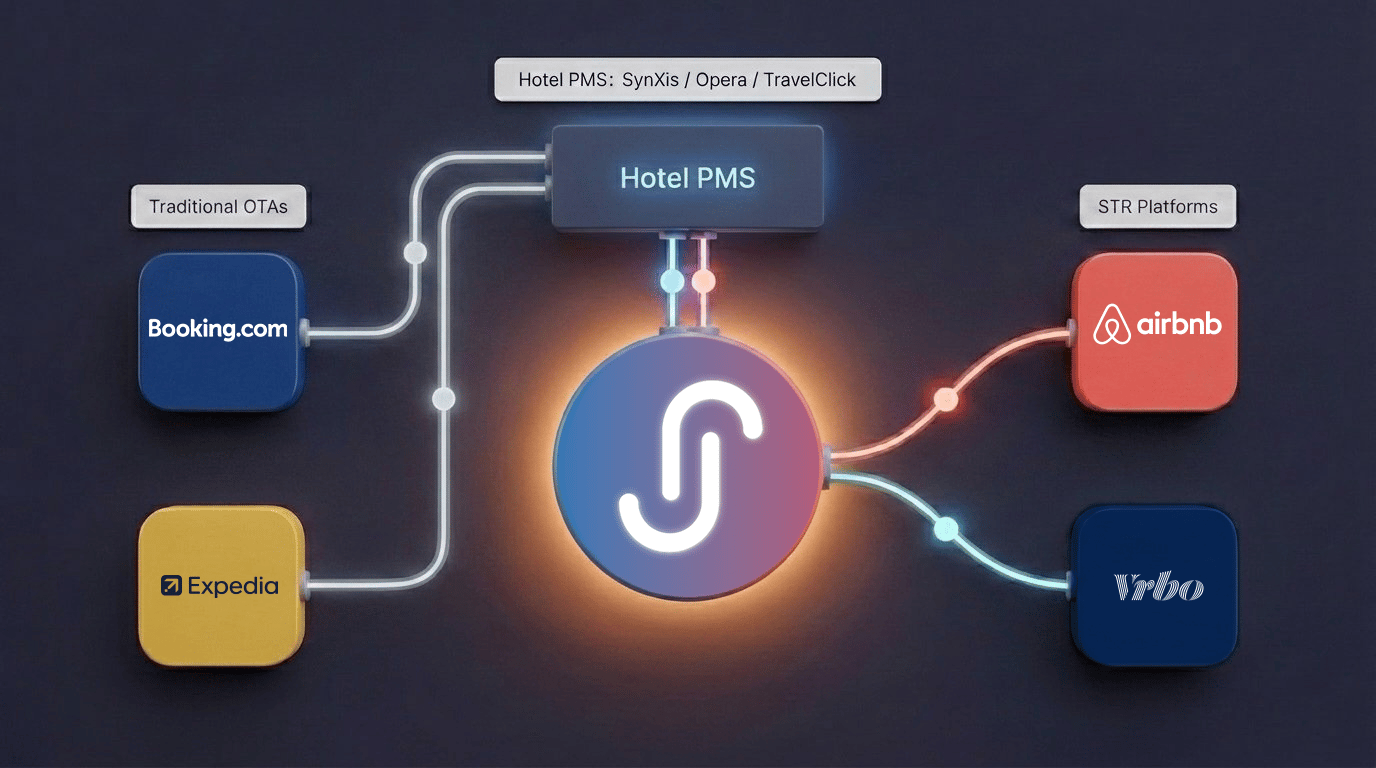
The technical workflow looks like this. Your existing PMS (SynXis, Opera, TravelClick, RoomMaster, or whatever powers your reservations) sends rate and availability data to a channel manager. The channel manager translates that data into the format Airbnb's API expects, including the structural differences between hotel rate plans and Airbnb's pricing model. Bookings that come in through Airbnb flow back to your PMS in real time, closing the inventory across all your other channels simultaneously. Guest messages from Airbnb's platform can be routed to your central reservations system or kept inside Airbnb depending on your operational preference.
Jetstream specializes in this integration layer for hotels. The platform connects hotel PMS systems like SynXis, Opera, and TravelClick directly to Airbnb and VRBO, handling the rate translation, inventory sync, and reservation data flow automatically. The TravelClick + Jetstream integration, for example, lets TravelClick-powered hotels expand their reach to Airbnb without rebuilding their tech stack.
For boutique and independent hotels without a dedicated revenue management team, this kind of integration is what makes Airbnb practical. Without it, listing on Airbnb is a manual workflow. With it, Airbnb becomes another channel in the distribution mix, no different operationally from Booking.com or Expedia.
Is Airbnb for Hotels the Right Fit for Your Property?
Not every hotel benefits equally from Airbnb. The properties that get the most value tend to share certain characteristics, and recognizing whether your hotel fits that profile is worth doing before you invest in the listing setup.
Hotels with larger room categories, suites, or condo-style units typically see the strongest performance because those room types match what Airbnb travelers are searching for. A standard 250-square-foot urban hotel room competes against vacation rentals on Airbnb without the things that make Airbnb appealing (more space, kitchen, multiple bedrooms). A junior suite, a one-bedroom condo unit, or a cottage-style room competes well.
Hotels in leisure destinations, gateway cities, beach markets, ski markets, and weekend-getaway destinations tend to outperform hotels in pure business markets. Airbnb's traffic skews leisure, so leisure-oriented properties are searching the same demand pool the platform already serves heavily.
Hotels willing to update their photography and listing content for Airbnb's audience outperform hotels that copy-paste their Booking.com gallery. The platform rewards effort.
If your hotel doesn't fit those characteristics yet, that doesn't mean Airbnb is closed to you. It means starting smaller is the right move. Most hotels begin by listing a portion of their inventory (the suites, the condo units, the rooms that fit the platform's audience), running it for a few months, and expanding based on performance. That approach lets you test the airbnb for hotels playbook against your real demand without committing your full inventory upfront.
The hotels making Airbnb work for them treat it as a serious distribution channel. They list their best inventory, optimize for the platform, and run the operational sync through technology rather than staff. For those operators, the airbnb for hotels question shifts away from whether to participate and toward how much of the channel's demand they want to capture.
Hotels exploring Airbnb and VRBO distribution can learn more about how hotel revenue management and channel distribution connects hotel systems to vacation rental platforms.
Our top picks |
|
|

READ: How Jetstream Powers Vail Resorts’ Airbnb and VRBO Strategy |

WATCH: CEO of Jetstream Shares Growth Tips for Airbnb & VRBO |