
A hotel distribution strategy is the plan that decides where, when, and on what terms your rooms appear in front of guests. Most hotels do not have one. They have a list of channels they connect to, a contract they signed at some point with each, and a vague sense that more visibility is better. That is a billboard, not a plan.
The properties that win in 2026 think about distribution the way a portfolio manager thinks about asset allocation. Each channel earns its place by contributing something the others cannot, and the mix is rebalanced as the market moves. This guide walks through the full hotel distribution strategy stack: what it is, what the landscape looks like today, how to build a defensible plan, where OTAs fit, why short-term rental platforms have moved from optional to core, and how to measure whether any of it is working.
What Is a Hotel Distribution Strategy?
A hotel distribution strategy is the deliberate plan for how a property makes its rooms available for booking across every channel a guest might use to find them. It covers which channels you sell on, what rates and inventory each channel sees, how the cost of each channel compares to the revenue it produces, and how those choices change with seasonality, segment, and demand.
Channel count is not the same as strategy. A property listed on twelve OTAs without rate discipline is a property leaking money in twelve directions. A property listed on three carefully chosen channels, each priced and positioned for a different segment, is running a strategy. The difference shows up in net average daily rate, in mix of business, and in the percentage of revenue that survives the trip from reservation to bank account.
Distribution without strategy creates predictable failures: rates drift out of parity because no one is monitoring every channel at once, bookings arrive for inventory the property already sold elsewhere, commission costs creep up year over year as the OTA share grows, and direct booking percentage falls because nothing is actively defending it. These failures don't show up as a single line item on a P&L; they show up as a slow erosion of margin that is hard to attribute to any one decision.
A working strategy answers four questions for every channel: what segment of demand does it bring, what does it cost per booking after every fee is counted, what role does it play in the overall portfolio, and what is the goal for its share of revenue over the next twelve months.
The Hotel Distribution Landscape in 2026
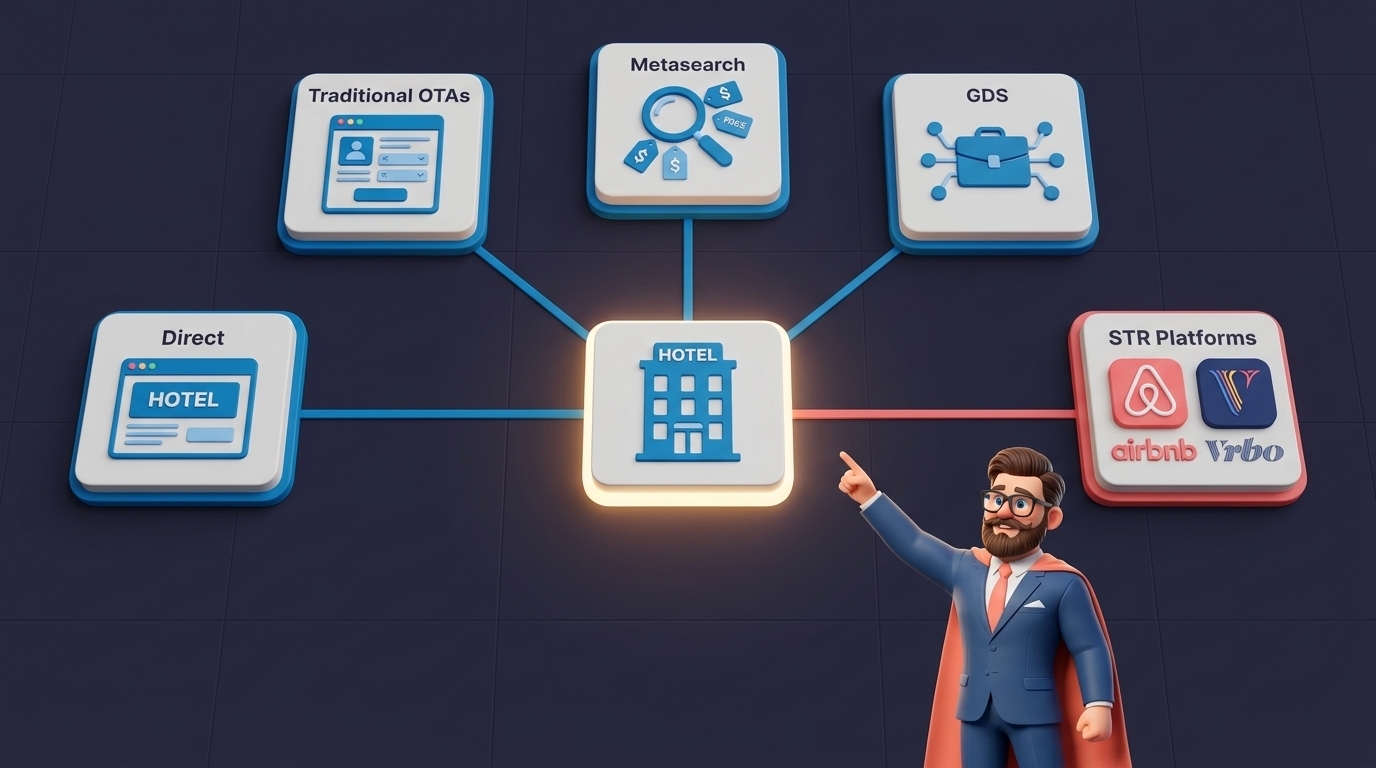
The modern landscape of hotel distribution channels is wider than it has ever been, and the boundaries between categories have softened. A revenue manager planning a channel mix today is choosing across five real categories, not the three that defined the playbook a decade ago.
Traditional OTAs. Booking.com and Expedia remain the two largest demand drivers in most hotel markets, with Hotels.com, Agoda, and a long tail of regional players filling out the category. They convert browsing intent into reservations at a rate no other channel matches, and they pay for that performance with commissions in a high single-digit to low double-digit range, depending on the contract, the rate plan, and the visibility tier. They are the most reliable demand source, and the most expensive.
Metasearch. Google Hotel Ads, Trivago, Kayak, and Tripadvisor sit between the OTAs and the direct channel. They aggregate rates from multiple sources, send the click to whichever channel the guest selects, and charge either a cost-per-click or a commission on the resulting booking. Metasearch can be a powerful tool for defending direct-booking share when it is wired into the right bidding strategy. It can also be a quiet drain when bids are set without margin discipline.
Global distribution systems. Sabre, Amadeus, and Travelport still matter, especially for properties chasing corporate, group, and travel-management-company business. The volume is smaller than it was at the peak, but the average rate and length of stay tend to be higher. SynXis, the central reservation platform owned by Sabre, sits in this stack for many full-service hotels.
Direct booking. The hotel website, booking engine, and call center are the channel where every booking arrives without commission. Direct also tends to bring the highest rate and the most data: contact information, preferences, repeat-stay history. The work of growing direct is unglamorous and slow, which is why properties consistently underinvest in it. The properties that do invest, with a fast booking engine, smart loyalty pricing, and metasearch defense in place, recover meaningful margin.
Short-term rental platforms. Airbnb and VRBO have moved from a category most hotel operators ignored into a category many of them now treat as core. Airbnb finished 2024 with $81.8 billion in gross booking value and 491.5 million nights and experiences booked, per its Q4 2024 shareholder letter. That is a demand pool the size of a top-five OTA, with guest demographics, length-of-stay patterns, and price sensitivity that look meaningfully different from Booking.com or Expedia. Hotels with the right inventory mix, condo-style units, suites, cottages, villas, are now treating Airbnb and VRBO as additive distribution rather than competition. That shift is well underway, and we have written about it in why OTAs alone are not enough in 2026.
The five categories overlap at the edges. Metasearch sits between OTAs and direct. STR platforms compete with OTAs for the same booking. The right hotel distribution strategy treats all five as inputs to a single mix rather than as separate silos.
How to Build a Hotel Distribution Strategy
A real strategy starts with a baseline. Pull the last twelve months of bookings and group them by channel, then build a per-channel scorecard that includes more than gross revenue. The columns that matter are gross room revenue, total commissions and fees paid, payment processing costs, the labor cost of managing that channel, average daily rate, length of stay, lead time, and cancellation rate. The result is the true cost of each channel, and it almost always reorders the picture in ways the headline numbers do not show.
A booking that looks like a winner at the top of the funnel can lose its margin to commission, marketing fees, and credit card costs by the time it lands in the bank account. A direct booking with a slightly lower rate often clears more profit than an OTA booking at the rack rate. The scorecard makes those tradeoffs visible.
With the baseline in place, the next step is to identify the gaps. There are three categories worth looking for.
A coverage gap exists when a segment of demand is active in the market and the property has no presence in the channel that serves it. The clearest current example is properties with kitchen-equipped or condo-style inventory that are not yet on Airbnb or VRBO. Demand for those units lives mostly on STR platforms, and a property that ignores the channel ignores the demand.
Rate gaps show up when a property is selling to a segment at a rate the channel does not justify. Selling a peak-season corporate-friendly room on a leisure metasearch placement, for example, leaves money on the table. Aligning rate plans to the segment that each channel actually attracts recovers that margin.
Margin gaps are the third category, and they tend to hide in plain sight. A high-commission OTA running at thirty percent of total bookings is fine if the rate is high enough, the contribution to occupancy is real, and the alternatives are limited. It becomes a problem if the property could replace some of that volume with a lower-cost channel and is simply not doing the work.
Once the baseline and the gaps are clear, the strategy turns into a set of channel-level goals. A reasonable target structure looks something like this: a defended floor for direct booking share (often twenty to thirty percent for full-service hotels), a cap on any single OTA's share of revenue (usually twenty-five to thirty-five percent depending on market position), a metasearch budget tied to a target return on ad spend, and an explicit growth target for any newly added channel. None of those numbers is universal. They are the output of the per-property baseline.
The plan then gets reviewed quarterly, not annually. Distribution moves too quickly for an annual cycle. Booking.com adjusts its visibility tiers, Google rolls out a new bidding model, Airbnb updates its search algorithm, a new partner integration becomes available. A quarterly review keeps the mix honest.
Technology for Distribution: Channel Managers, PMS Integration, and Automation
A distribution strategy is only as good as the systems that execute it. The technology stack that holds the strategy together has three layers: the property management system, the channel manager, and the integrations between them and every distribution endpoint.
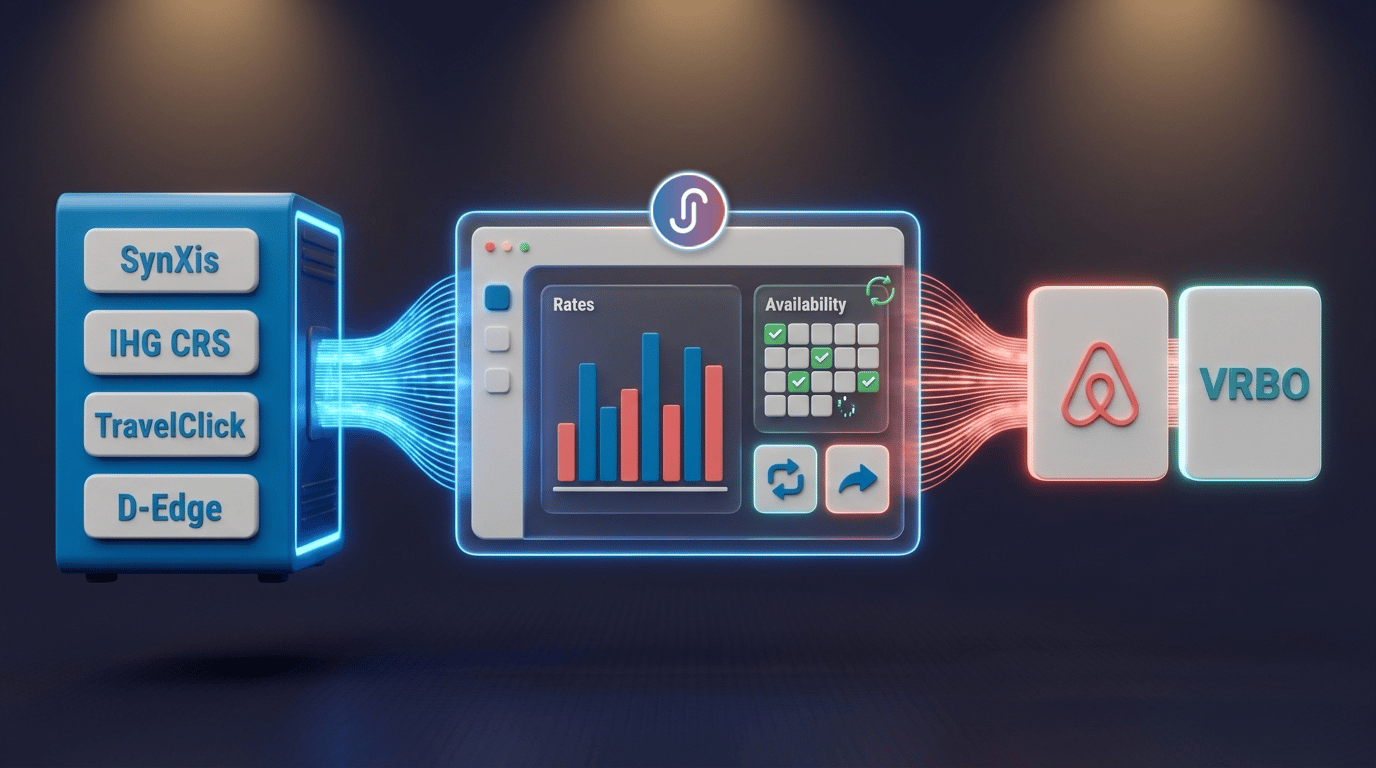
The PMS is the source of truth. It holds the rates, the availability, the inventory, the bookings, and the guest data. The CRS, where one is in use, sits next to it for centralized rate and inventory management across multiple properties. SynXis, IHG CRS, TravelClick (Amadeus), D-Edge, and YieldPlanet are the most common platforms in the full-service hotel segment.
The channel manager is the layer that connects the PMS or CRS to every distribution endpoint and keeps the data in sync. When a guest books a room on Booking.com, the channel manager pushes that booking back into the PMS and decrements availability everywhere else. When the revenue manager raises the rate in the PMS, the channel manager pushes the new rate to every connected channel. The architecture is simple to describe and difficult to do well, because the failure mode of a bad channel manager is overbooked rooms and rate parity violations, both of which are expensive.
The hard problem in 2026 is that most hotel channel manager products do not natively connect to Airbnb and VRBO. They were designed for an OTA world, with rate plan structures, room type definitions, and inventory logic that match how Booking.com and Expedia think. Airbnb and VRBO operate on a different model: listings are unit-level rather than room-type-level, pricing logic follows different rules, and content requirements are richer. The channel managers that handle hotel-to-STR distribution well are typically purpose-built for that bridge.
This is where Jetstream operates. Our channel management product takes hotel ARI data from PMSs and CRSs like SynXis, TravelClick, D-Edge, IHG CRS, and others, and distributes it accurately to Airbnb and VRBO with the listing content, pricing logic, and 24/7 guest services that the platforms require. The product was built by revenue managers, for revenue managers, and the partners using it tend to be hotels and resorts with condo-style or suite inventory looking to add STR channels to a distribution strategy already running through traditional OTAs.
The point of the technology layer is to make the strategy executable, not to add channels for their own sake. A strategy that requires the revenue team to manually update rates across six channels every morning is a strategy that will not survive contact with a busy week. The right stack runs the mix automatically and frees the team to think about the strategy itself.
Measuring Distribution Performance
A distribution strategy that cannot be measured is a distribution strategy that will not be improved. The metrics that matter live one layer below the headline numbers most properties report.
Net ADR by channel. Gross average daily rate is what the guest pays. Net ADR is what the property keeps after commissions, payment fees, marketing fees, and any other channel-specific costs. Two channels can have the same gross ADR and very different net ADRs. The net number is the one that matters when comparing channels.
RevPAR contribution by channel. Total revenue per available room is the operational benchmark of the property. Breaking it down by channel shows which channels are doing the work of filling the property and which are only contributing at the margins.
Channel ROI. For paid channels (metasearch, OTA visibility programs, direct marketing), the return on every marketing dollar is the cleanest signal of whether the spend is justified. The arithmetic is straightforward: net revenue produced by the channel, minus the marketing and commission cost, divided by that cost.
Length of stay and lead time by channel. These two are operational rather than financial, but they reshape strategy. A channel that brings shorter lead times allows for higher last-minute pricing. A channel that brings longer stays reduces operational cost per night. Both should be tracked as channel attributes, not just averages across the property.
Direct booking percentage. The single most defensive metric in the stack. A property that loses share of direct booking over time is a property that is becoming more dependent on paid channels. The trend matters more than the absolute number. A direct share moving from twenty-five percent to twenty percent over twelve months is a warning, even if the property is still profitable.
Mix by segment. Distribution strategy is also a segment strategy. Tracking mix by leisure, corporate, group, and any platform-specific segments (long-stay STR guests, last-minute urban) clarifies whether the channel mix is actually doing the segmentation work it is supposed to do.
The cadence for reviewing these metrics is monthly at the operational level and quarterly at the strategic level. Monthly reviews catch tactical issues: a sudden drop in direct, a spike in cancellations from one channel, a parity violation. Quarterly reviews surface bigger questions, like whether the OTA share is trending up because demand shifted or because the direct work has stalled, and whether a channel should be added or pulled.
Where to Take a Hotel Distribution Strategy from Here
Distribution strategy is the layer of revenue management most properties under-invest in. The mix that worked in 2018 does not work in 2026, because the categories themselves have changed: STR platforms are no longer optional for hotels with the right inventory, direct booking does not defend itself, and metasearch does not optimize itself. The properties that grow net revenue over the next two years will be the ones that treat distribution as a continuous discipline rather than a once-a-year decision.
The starting point is the baseline. Pull the per-channel scorecard. Look at net ADR, not gross. Identify the gaps. Build the first version of the channel-level goals. Then iterate, quarter by quarter, as the market moves.
For hotels and resorts looking specifically at how to add Airbnb and VRBO to their distribution strategy without taking on the operational and content burden, that is the work Jetstream does. We connect to your existing PMS or CRS, distribute your ARI accurately to the right STR platforms, manage the listing content, and run 24/7 multilingual guest services on your behalf. You can see how it works on our hotel revenue management page.
If your distribution strategy includes adding Airbnb and VRBO to your channel mix, Jetstream is built for that exact bridge. We connect to your existing PMS or CRS, run the listings, and handle 24/7 guest communication, with a shared-success commercial model so you only pay when you get paid.